> For the complete documentation index, see [llms.txt](https://man572142s-organization.gitbook.io/broaudio/llms.txt). Markdown versions of documentation pages are available by appending `.md` to page URLs; this page is available as [Markdown](https://man572142s-organization.gitbook.io/broaudio/core-features/no-code-components/sound-volume.md).
# Sound Volume
Controls the volume for a specified BroAudioType
{% hint style="info" %}
This component is particularly useful in the following situations
1. **Slider Binding**: Easily bind this component to a [UI slider](https://docs.unity3d.com/2022.3/Documentation/Manual/script-Slider.html) to quickly implement volume control for your game.
2. **Quick Volume Adjustment**: Temporarily adjust the volume of a specific audio type when an event occurs by enabling or disabling this component.
{% endhint %}
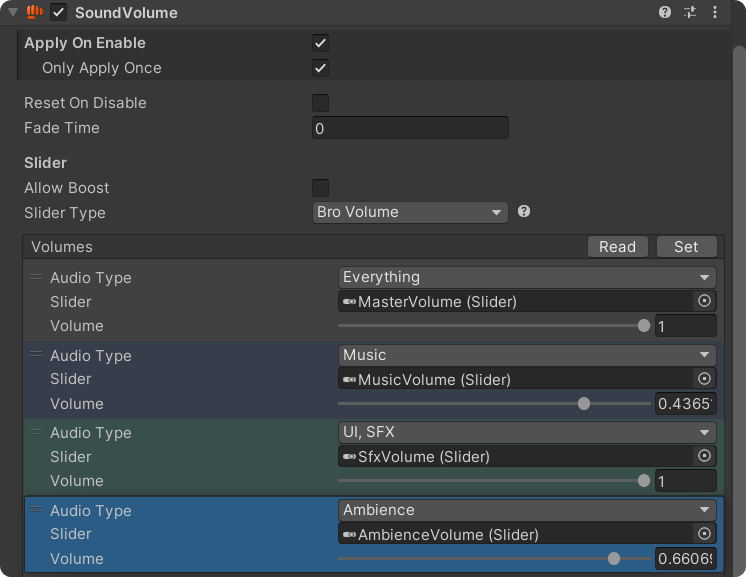
## Apply On Enable
Check this box to automatically apply the volume setting whenever the GameObject is enabled.
**Only Apply Once:** Applies the settings only the first time the GameObject is enabled.
## Reset On Disable
Check this box to automatically reset the volume back to the time before onEnable when the GameObject is disabled.
## Fade Time
The duration it takes to reach the target volume.
## Slider
**Allow Boost:** Check this box to allow volumes beyond 0dB.
**Slider Type:** Determines the scale of the slider, which will also affect the [UnityEngine.UI.Slider](https://docs.unity3d.com/2022.3/Documentation/Manual/script-Slider.html) assigned in the Volumes list below.
## Volumes
**Audio Type:** The target audio type to apply the volume to. You can select multiple types or set it to 'Everything' to act as a master volume control.
**Slider(optional):** The [Unity UI Slider](https://docs.unity3d.com/2022.3/Documentation/Manual/script-Slider.html) component that syncs with the volume.
**Volume:** The volume level.
**\[Read]**** button****:** Converts the UI Slider value to volume.
**\[Set]**** button****:** Converts the volume to the UI Slider value.
**\[Edit in Playmode]**** button****:** Available in Playmode. If enabled, the volume applies directly to the system, useful for debugging.